
The Strategic Capability Framework for Professional Firms
Sustainable success depends on far more than strategy alone. Discover how the Strategic Capability Framework helps professional firms align leadership, people, learning, governance and organisational performance into a single integrated system that creates long-term organisational capability.
Introduction
Every professional firm has a strategy. Growth targets are established. Business plans are written. Investments are made. Technology is implemented. Yet many firms discover that even well-designed strategies fail to deliver their intended results. The reason is rarely a lack of ambition. More often, organisations struggle because they focus on what they want to achieve without giving equal attention to how the organisation develops the capability to achieve it.
Strategy without capability is aspiration. Capability without direction lacks purpose. Long-term success requires both. This is the principle behind the Strategic Capability Framework.
Rather than viewing strategy, leadership, learning, governance and organisational development as separate disciplines, the framework brings them together into a single integrated model that enables professional firms to deliver consistent performance while adapting confidently to continual change.
What Is Strategic Capability?
Strategic capability is an organisation’s ability to deliver its strategic objectives consistently over time. It extends beyond financial performance. It reflects the collective strength of the organisation’s:
- leadership;
- people;
- culture;
- governance;
- knowledge;
- learning;
- systems;
- decision-making.
Unlike short-term performance, strategic capability focuses on creating sustainable organisational success. It enables firms not only to respond to change but to anticipate and lead it.
Why Professional Firms Need a Different Approach
Professional firms differ from many other organisations. Their greatest asset is not machinery or intellectual property. It is professional expertise. Success depends upon the capability of people to deliver trusted advice, exercise sound judgement and build enduring client relationships. This creates a distinctive challenge. Organisational performance depends upon developing professional capability at every level. Strategy therefore cannot be separated from learning, leadership or organisational culture. Each influences the others.
The Six Pillars of Strategic Capability
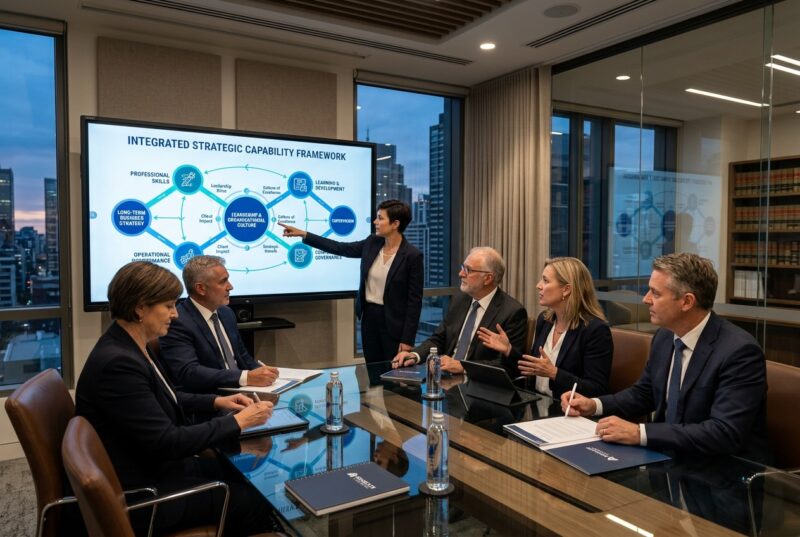
The Strategic Capability Framework brings together six mutually reinforcing pillars.
1. Leadership
Leadership establishes purpose, direction and organisational culture. It creates the environment in which capability develops. Effective leaders:
- communicate vision;
- develop people;
- encourage learning;
- strengthen collaboration;
- support continual improvement.
Leadership is therefore the catalyst for organisational capability.
2. Professional Capability
Professional capability combines:
- technical expertise;
- professional skills;
- judgement;
- commercial awareness;
- ethical behaviour;
- continual learning.
Developing capability is not solely an individual responsibility. It is an organisational investment.
3. Learning and Development
Learning enables organisations to adapt. However, learning should not be viewed simply as training. It includes:
- workplace experience;
- supervision;
- coaching;
- mentoring;
- reflective practice;
- knowledge sharing.
Learning becomes embedded within everyday professional practice.
4. Governance and Assurance
Strong organisations understand how capability is developed, supported and evidenced. Governance provides:
- oversight;
- accountability;
- organisational assurance;
- continual improvement;
- informed decision-making.
Effective governance strengthens confidence without creating unnecessary bureaucracy.
5. Organisational Culture
Culture influences behaviour every day. It determines whether people:
- collaborate openly;
- seek feedback;
- share knowledge;
- learn from mistakes;
- support one another.
Healthy cultures accelerate capability development while strengthening resilience.
6. Continuous Improvement
Professional firms operate within environments that change constantly. Technology evolves. Client expectations increase. Regulation develops. Continuous improvement enables organisations to respond confidently by encouraging reflection, innovation and organisational learning.
Integration Creates Capability
The greatest strength of the Strategic Capability Framework lies not within its individual components but in the way they work together. Leadership shapes culture. Culture influences learning. Learning develops professional capability. Capability strengthens organisational performance. Governance provides confidence. Continuous improvement ensures the organisation continues adapting. Each element reinforces the others. This integration transforms isolated initiatives into a coherent organisational system.
From Individual Development to Organisational Performance
Many organisations invest heavily in individual development. The Strategic Capability Framework extends this thinking. It asks:
- How do individual capabilities combine to create organisational capability?
- How does leadership influence learning?
- How does governance support continual improvement?
- How do professional skills contribute to strategic objectives?
These questions help organisations connect people development with long-term business performance.
A Framework for Sustainable Growth
Growth creates new demands. More people. More clients. More complexity. Without deliberate capability development, growth often places increasing pressure on leadership, supervision and organisational systems. The Strategic Capability Framework ensures that organisational capability grows alongside commercial success. This creates more sustainable expansion while reducing operational risk.
Supporting Future-Ready Organisations
Artificial intelligence, digital transformation and changing client expectations are reshaping professional services. Future-ready organisations will require more than technical expertise.
They will need:
- adaptable leaders;
- resilient cultures;
- effective learning systems;
- strong governance;
- collaborative professional environments.
The Strategic Capability Framework provides a structured approach to developing these capabilities systematically.
Why the Framework Matters
Professional firms frequently implement individual improvement initiatives. Leadership programmes. Learning platforms. Governance reviews. Technology projects. Culture initiatives. Each may be valuable. However, lasting improvement occurs when these activities are aligned within a coherent strategic framework. The Strategic Capability Framework provides that alignment. It enables organisations to understand capability as an integrated management system rather than a collection of disconnected activities.
Looking Ahead
The organisations that thrive during the next decade will not necessarily be those with the largest budgets or the most sophisticated technology. They will be those capable of learning continuously, developing their people deliberately and adapting confidently to changing environments. Strategic capability will increasingly become the defining characteristic of successful professional firms. Building that capability begins with recognising that sustainable success is created through the integration of leadership, learning, governance, culture and professional development.
Key Takeaways
- Strategic capability enables organisations to deliver long-term success rather than short-term performance.
- Professional firms require an integrated approach linking leadership, learning, governance and culture.
- The Strategic Capability Framework aligns six mutually reinforcing organisational pillars.
- Organisational capability develops when individual development is connected to strategic objectives.
- Firms that invest systematically in strategic capability become more resilient, adaptable and sustainable.
Conclusion
Professional firms operate in an environment of continual change. Technology, regulation, client expectations and competition will continue evolving. The organisations that succeed will be those capable of evolving with them. The Strategic Capability Framework provides a practical model for achieving this. By integrating leadership, professional capability, learning, governance, organisational culture and continuous improvement, firms create resilient organisations capable of delivering sustained performance while continually strengthening their greatest asset—their people. Ultimately, strategy defines where an organisation wants to go.
Strategic capability determines whether it can get there.
CONTINUE READING
Read Other Articles in This Series
Previous Article

Why Strategic Thinking Is Becoming a Competitive Advantage
Next Article
What Strategic Thinking Looks Like in Professional Firms
Explore Related Topics

Measuring Strategic Capability: Turning Organisational Insight into Executive Decision-Making
Recommended Next Step

Why Law Firm Leaders Struggle with Strategic Thinking