
What Strategic Thinking Looks Like in Professional Firms
Strategic thinking is often discussed as though it were an abstract concept or a characteristic possessed only by senior leaders. In reality, strategic thinking is a practical capability that can be observed, developed and applied throughout professional organisations. Understanding what strategic thinking looks like in practice helps firms move beyond theory and begin developing it intentionally.
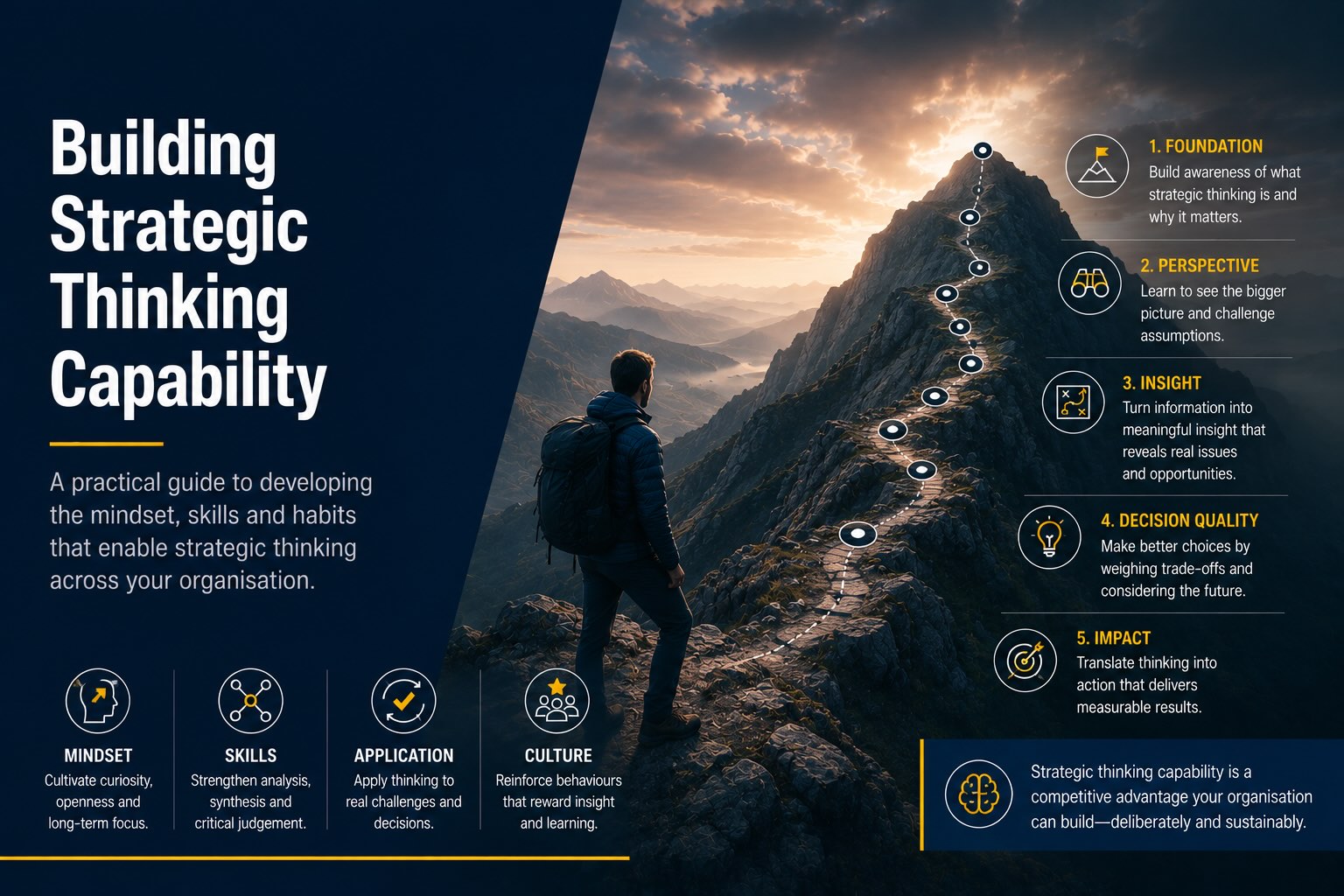
The Challenge of Defining Strategic Thinking
Most professionals recognise strategic thinking when they encounter it. Defining it, however, is often more difficult. Terms such as “strategic mindset”, “big-picture thinking” and “commercial awareness” are frequently used, yet they can feel vague and open to interpretation. This ambiguity creates a challenge for organisations seeking to develop strategic capability. If strategic thinking cannot be clearly identified, it becomes difficult to support, assess or develop. Fortunately, strategic thinking is not an abstract quality. It is visible through behaviour. The question is not whether strategic thinking exists. The question is what it looks like in practice.
Strategic Thinking Is Observable Behaviour
Strategic thinking is often mistaken for intelligence, seniority or personality. In reality, it is better understood as a set of behaviours and approaches that influence how individuals interpret situations and make decisions. Strategic thinkers tend to:
- Consider broader implications
- Explore longer-term consequences
- Evaluate multiple perspectives
- Connect actions to wider objectives
- Anticipate future developments
These behaviours can be observed in meetings, conversations, decision-making processes and day-to-day professional practice. Strategic thinking is therefore something people do rather than something they simply possess.
Looking Beyond Immediate Tasks
One of the clearest indicators of strategic thinking is the ability to move beyond immediate operational concerns. Operational thinking often focuses on:
- Current tasks
- Immediate problems
- Short-term priorities
- Existing processes
Strategic thinking extends the horizon. Strategic thinkers regularly ask:
- What happens next?
- How might this develop?
- What are the wider consequences?
- How does this support longer-term objectives?
This broader perspective allows individuals to make decisions that support both immediate performance and future outcomes.
Considering Multiple Perspectives
Strategic thinkers rarely view issues from a single standpoint. Instead, they consider how decisions may affect different stakeholders, objectives and organisational priorities. For example, when evaluating a proposal, they may consider:
- Client impact
- Commercial implications
- Operational requirements
- Resource constraints
- Long-term consequences
This wider perspective often leads to more balanced and informed decision-making. It also helps reduce the risk of solving one problem while unintentionally creating another.
Connecting Individual Actions to Organisational Objectives
Strategic thinking involves understanding how day-to-day activities contribute to broader organisational goals. Professionals who think strategically tend to recognise the connection between:
- Individual decisions
- Team performance
- Organisational priorities
- Long-term outcomes
For example, they may ask:
- How does this support our objectives?
- What impact will this have on the client experience?
- Does this align with our wider priorities?
This alignment helps ensure operational activity contributes to strategic progress.
The Role of Judgement
Judgement sits at the heart of strategic thinking. Many professional situations involve uncertainty. Information may be incomplete, priorities may conflict and there may be no obvious right answer. Strategic thinkers demonstrate judgement by:
- Evaluating available evidence
- Considering alternative options
- Balancing risks and opportunities
- Assessing potential consequences
Importantly, judgement is not simply about making decisions. It is about making decisions with awareness of their broader context. This capability becomes increasingly important as responsibilities grow.
Commercial Awareness Supports Strategic Thinking
Commercial awareness is often associated with business development or financial management. However, it also plays an important role in strategic thinking. Professionals who understand:
- Client priorities
- Market conditions
- Organisational objectives
- Economic pressures
are often better positioned to evaluate decisions strategically.
Commercial awareness provides context. It helps individuals understand why certain decisions matter and how different factors influence organisational performance. Strategic thinking becomes stronger when supported by commercial understanding.
Strategic Thinkers Ask Different Questions
One practical way to recognise strategic thinking is to observe the questions people ask. Operational questions often focus on:
- What needs to be done?
- When must it be completed?
- Who is responsible?
Strategic questions often explore:
- Why does this matter?
- What are the wider implications?
- What could happen next?
- How does this align with our objectives?
- What opportunities or risks are emerging?
The quality of these questions often shapes the quality of decisions. Strategic thinking begins with curiosity and perspective.
Strategic Thinking Can Be Practised
Because strategic thinking is behavioural, it can be developed. Professionals can strengthen strategic capability by:
- Reflecting on decisions
- Seeking broader perspectives
- Exploring longer-term consequences
- Participating in strategic discussions
- Increasing commercial awareness
- Learning from organisational challenges
Over time, these activities help individuals build the habits associated with strategic thinking. The capability becomes stronger through deliberate practice rather than passive experience.
Developing Strategic Thinking Within Organisations
Firms seeking to strengthen strategic capability should focus on creating opportunities for strategic thinking to occur. Examples include:
- Cross-functional projects
- Business planning activities
- Client strategy discussions
- Leadership development programmes
- Reflective learning activities
- Mentoring and coaching
These experiences encourage professionals to think beyond immediate responsibilities and engage with wider organisational issues. Strategic thinking develops most effectively when it becomes part of everyday professional practice.
Key Takeaways
- Strategic thinking is observable behaviour rather than a personality trait.
- Strategic thinkers consider longer-term consequences and wider implications.
- Strategic thinking involves perspective, judgement and organisational awareness.
- Commercial understanding strengthens strategic capability.
- Strategic thinkers connect decisions to broader objectives.
- The questions people ask often reveal the quality of their strategic thinking.
- Strategic thinking can be practised and developed.
Conclusion
Strategic thinking is often portrayed as an abstract or specialist capability reserved for senior leaders. In reality, it is a practical professional skill that can be observed, developed and applied across organisations. Professionals who think strategically look beyond immediate tasks, consider broader implications and connect decisions to longer-term objectives. These behaviours support stronger judgement, more informed decision-making and greater organisational effectiveness. Understanding what strategic thinking looks like is an important first step. Developing it intentionally is the next.
If your organisation is seeking to strengthen strategic capability, consider how strategic thinking behaviours are currently recognised, encouraged and developed. The ability to identify and nurture these behaviours may have a significant influence on future organisational performance.
CONTINUE READING
Read Other Articles in This Series
Previous Article

Creating a Capability-Led Organisation: The Future of Professional Services
Next Article

From Strategic Thinking to Strategic Capability
Explore Related Topics

Developing Strategic Thinking in Early-Career Lawyers
Recommended Next Step
-
From Strategic Thinking to Strategic Capability